How to Avoid Decision Fatigue in Your Beauty Routine
Last Updated: November 17, 2026
Quick Summary
To avoid decision fatigue beauty routines, cut your daily choices to a short, fixed set of products and steps. Pick three to five essentials such as a gentle cleanser, moisturizer, and broad-spectrum sunscreen, then set a default morning and evening sequence you repeat every day.
- Pick three to five essential products, such as a cleanser, moisturizer, and sunscreen.
- Write a fixed morning and evening sequence on a card near the sink.
- Aim for about three to five minutes in the morning and five to ten at night.
- Introduce one targeted treatment at a time and give it a few weeks before adding another.
- Declutter once a season, sorting products into keep, replace, and finish or give away.
Table of Contents
- Why Beauty Routines Drain Your Daily Decision Energy
- How Too Many Products and Choices Add to Mental Load
- How to Simplify a Skincare Routine in Five Steps
- A Daily Skincare Routine for Busy Professionals
- Simplifying Makeup for Everyday and Occasion Looks
- A Skincare Routine Checklist and Product Decluttering Plan
- How to Organize Beauty Products So Choices Stay Simple
- Start Your Simpler Routine With CanvasSkinLab's Curated Essentials
- Frequently Asked Questions
Why Beauty Routines Drain Your Daily Decision Energy
Decision fatigue is the drop in quality you see after making many small choices in a row, and it is one reason the decision fatigue beauty problem feels so common. Every morning, a beauty routine asks you to pick a cleanser, a serum, a moisturizer, and a sunscreen before you have had your coffee. This guide helps you cut those daily choices down to a short, reliable set.
Researchers have studied the idea behind this effect for years. A 2018 conceptual analysis by Pignatiello and colleagues describes decision fatigue as a hypothesis that clinicians under mental strain may choose practices that drift from evidence-based guidance (Decision Fatigue: A Conceptual Analysis, Pignatiello and colleagues, 2018). That paper frames the effect as a concern to test, not a proven rule, so treat it as a useful lens rather than settled fact.
Beauty shoppers feel the same pressure. Drug Store News reports that 72% of consumers feel overwhelmed by the volume of new product launches, with younger shoppers reporting the highest fatigue (Drug Store News beauty trends coverage, 2026). The survey behind that figure is not identified in the source, so read it as a signal of how common the feeling is.
So what does this mean for your routine? Every extra product is one more decision to make, and those decisions add up. Cutting the number of choices is often the fastest way to feel less worn out before work.
How Too Many Products and Choices Add to Mental Load
Most people do not own too few products. They own too many, and they forget half of them.
Each extra bottle adds a small question: Is this the one for today? Multiply that by every step, and the routine starts to feel like homework.
- Duplicate serums that do similar jobs
- Masks that sit unused for months
- Trend products bought from a single social media video
- Samples that never get finished
These choices pile up quietly. Vogue's guidance on decision fatigue notes that consistent routines make daily life more predictable, though the goal is not to plan every minute (Vogue, What Is Decision Fatigue and What Can You Do About It?). The point is to reduce friction, not to eliminate every choice.
Watch out: Buying a new product to "fix" routine fatigue usually adds another decision. Stop buying before you simplify.
How to Simplify a Skincare Routine in Five Steps
Simplifying is easier when you follow a clear order. Work through these five steps once, and most of the daily guesswork that feeds decision fatigue beauty routines goes away.
Choosing a Short List of Essential Products
Start by picking the few products your skin actually needs. For most people, that means a gentle cleanser, a moisturizer, and a broad-spectrum sunscreen. Add one targeted treatment only if you have a specific concern.
Keep the list short enough to see at a glance. Three to five products is a practical range for most routines.
Setting Morning and Evening Defaults
Defaults remove the daily debate. Decide once what you do each morning and each evening, then repeat it.
- Morning: cleanse, moisturize, sunscreen
- Evening: cleanse, treatment, moisturize
Write the sequence on a card and keep it near the sink. When you are tired, you follow the card instead of thinking.
Simplifying is easier when you follow a clear order, and these five steps cover the essentials.
| Step | What to do | Time or frequency |
|---|---|---|
| Choose essential products | Pick a gentle cleanser, moisturizer, and broad-spectrum sunscreen | Three to five products |
| Set morning and evening defaults | Write a fixed sequence for each part of the day | Once, then repeat daily |
A Daily Skincare Routine for Busy Professionals
A routine saves decision energy when it is specific enough to follow without thinking. The goal is a fixed morning sequence and a fixed evening sequence, each with a default for every step, so the only decision left is whether to do the routine at all.
A workable target is about three to five minutes in the morning and five to ten minutes at night. Our basic skincare routine steps explain each step so you can set up your own daily sequence. Keep the steps identical on workdays and weekends; the fewer variations you allow, the fewer choices you face. Browse affordable skincare options that fit a busy schedule to find an easy routine that works for you.
Morning default (in order):
- Gentle cleanser or a rinse with lukewarm water if your skin is dry or sensitive
- Lightweight moisturizer
- Broad-spectrum sunscreen, SPF 30 or higher, applied as the last step
Evening default (in order):
- Cleanser to remove sunscreen, makeup, and the day's buildup
- One targeted treatment, used only if you have a specific concern such as acne, redness, or dullness
- Moisturizer to seal in hydration
Set the defaults once and write them on a card by the sink. When you are tired, you follow the card instead of weighing options. A common pattern is to keep the morning routine identical every day and reserve the single treatment step for evenings, which keeps the morning fast and leaves room for actives at night.
Build the routine around your own needs rather than a trend. If you use a retinoid, apply it at night and pair it with sunscreen the next morning, since retinoids can increase sun sensitivity.
Watch out: layering several strong actives (for example, a retinoid plus an exfoliating acid) in the same routine can irritate skin, so introduce one treatment at a time and give it a few weeks before adding another.
Multi-tasking products can reduce both purchases and decisions. A moisturizer with sunscreen can replace two morning steps, and a cleanser that also removes makeup can replace a separate makeup remover. Fewer products mean fewer purchases, fewer choices, and less clutter on the counter.
Consistency matters more than complexity. Repeating the same sequence daily lets your skin respond and spares you from reconsidering each step. If your skin changes with the seasons, adjust one product at a time rather than rebuilding the whole routine.
Simplifying Makeup for Everyday and Occasion Looks
Makeup adds another layer of choice, so build a small kit for everyday wear and a separate short list for special occasions. A tinted moisturizer, a neutral eyeshadow, a mascara, and one lip color cover most daily needs. See a short list of versatile everyday essentials for busy women.
For events, pick one occasion look and stick to it. Choosing a single bold feature, like a bright lip or a winged liner, keeps the decisions limited.
A Skincare Routine Checklist and Product Decluttering Plan
Decluttering is a decision-reduction exercise, not a cleaning project. The aim is to end with a small set of products that each earn their place, so every future choice is easier.
Step 1: Sort into three piles.
- Keep: products that match your routine and your skin type
- Replace: products that no longer suit your skin or have expired
- Finish or give away: duplicates, samples, and trend buys you will not use
Step 2: Check each product against a short checklist.
- Does this product fit my skin type and sensitivities?
- Have I used it in the past month?
- Does it overlap with another product in my routine?
- Do I know the ingredients and any known conflicts?
- Is it past its expiration or period-after-opening date?
Step 3: Replace one product at a time.
Replace a single item, use it for a few weeks, and decide whether it helped before changing anything else. This isolates cause and effect and keeps you from adding several new decisions at once. Patch-test new products on a small area, especially if your skin is sensitive.
Step 4: Watch for ingredient conflicts.
Some combinations are known to cause irritation or reduce effectiveness. A common pattern is to avoid layering a retinoid with a strong exfoliating acid in the same routine, and to use benzoyl peroxide and retinoids at different times of day. If you are unsure, introduce one active at a time and keep the rest of the routine bland and stable.
Step 5: Set a replacement rule.
Decide in advance what you will buy when a product runs out, and buy only that. A simple default, such as replacing the cleanser with the same cleanser unless your skin has changed, removes the shopping decision entirely.
Watch out: keeping expired products "just in case" recreates the clutter you are trying to remove, so check period-after-opening symbols and discard anything past its date.
Step 6: Review once a season.
A short quarterly review, not a weekly one, is enough. Re-sort, replace what is empty, and resist adding new categories unless a specific need appears. Fewer reviews mean fewer decisions, and a stable shelf means a stable routine.
How to Organize Beauty Products So Choices Stay Simple
Organization reduces decisions because you can see everything at once. Group your daily essentials on one tray, and store occasional items out of the way.
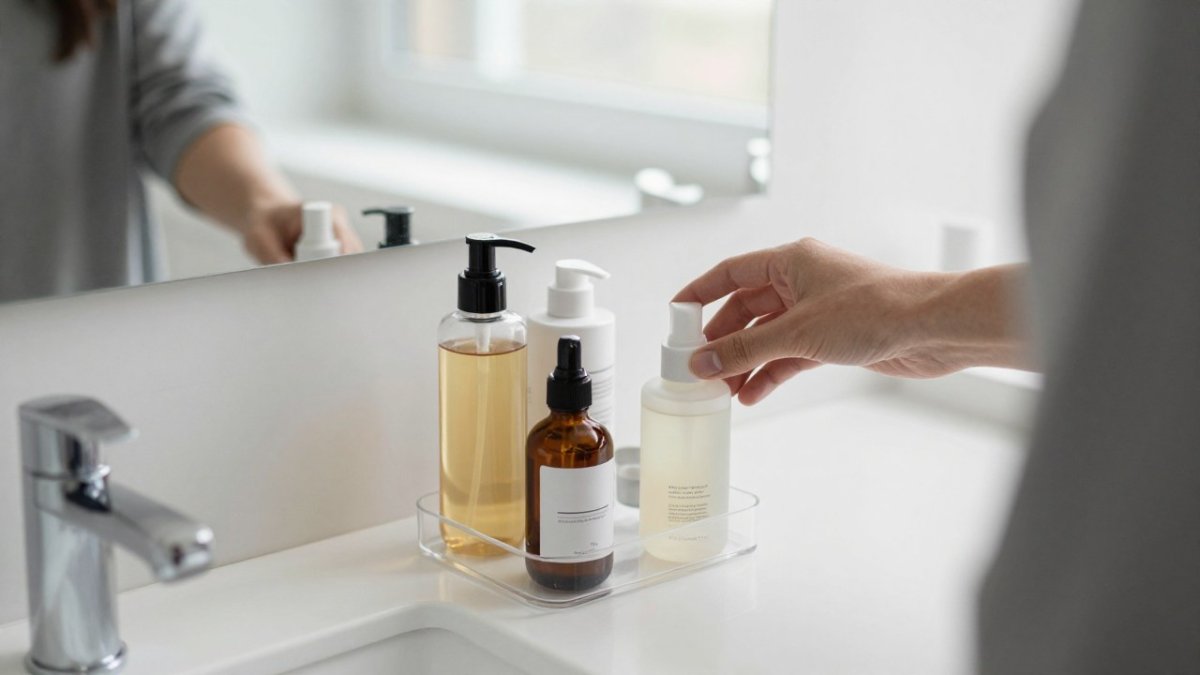
Place the products you use every morning in the front, in the order you use them. Move seldom-used items to a drawer or a higher shelf. When your shelf matches your routine, you stop searching and start using.
Start Your Simpler Routine With CanvasSkinLab's Curated Essentials
Simplifying your routine is easier when you start with products built for that purpose. CanvasSkinLab curates skincare, haircare, and self-care essentials to help you move from a crowded shelf to a short, effortless routine. Explore our all products collection to find replacements for the essentials you keep, or read how to start a skincare routine for a step-by-step starting point.
The selection is curated with busy schedules in mind. Pick a few essentials, set your defaults, and let the routine run itself. Visit CanvasSkinLab's website for current products and prices to build a shorter, calmer routine that feels good from morning to night.
Frequently Asked Questions
How do I get rid of decision fatigue in my beauty routine?
Start by fixing the decisions you make every day. Choose a small set of essential products, set a fixed order for your morning and evening steps, and keep a short shortlist of approved backups. When the routine is predetermined, you spend less mental energy each morning. Research on decision fatigue is still largely conceptual, so treat these steps as a practical experiment: track whether you feel less rushed and more consistent after two or three weeks.
How many products do I really need in a daily skincare routine?
Many people do well with three to five core steps: a gentle cleanser, a moisturizer, and daytime sun protection, with an optional treatment at night. Additional products can be added later if a specific skin need is not being met. Start with the basics, use them consistently for several weeks, and only then decide whether anything else earns a place on your shelf.
How can I make my morning beauty routine faster?
Assign each step a default product and a fixed order so you do not have to think about it. Keep the products you use every morning together in one place, and prepare the next day's essentials the night before. A shorter routine that you repeat without thinking usually beats an elaborate one you skip when you are rushed.
How do I simplify my skincare routine without irritating my skin?
Introduce products one at a time and wait a few weeks before adding another. If you have sensitive or combination skin, avoid stacking several active ingredients at once, and patch-test new products on a small area first. If irritation, redness or breakouts persist, consult a dermatologist rather than adding more products.