Clinical vs Natural Skincare: What the Claims Really Mean
Last Updated: November 15, 2026
Quick Summary
Clinical vs natural describes two different things: clinical usually signals that a product has been tested in some way, while natural describes where an ingredient comes from. Neither word alone tells you how well a product works or how gentle it will be on your skin.
- Clinical usually means a product was tested, but the label does not show whether the test was controlled or the result significant.
- Natural describes ingredient origin, and cosmetics have no single legal definition of the term in the United States.
- Natural products can contain allergens linked to contact dermatitis, so natural origin does not guarantee gentleness.
- Check concentration, finished-product testing, sample size, duration and a control group before trusting a clinically proven claim.
- Introduce one new product at a time and give it two to four weeks before judging results.
Table of Contents
- Natural vs. Synthetic Skincare Ingredients: What the Terms Actually Describe
- Why Natural Does Not Mean Safer: Allergens and Irritation
- What Makes an Ingredient Clinically Proven Skincare Ingredient
- How to Evaluate Skincare Claims: A Claim-by-Claim Checklist
- Clinical and Natural as Separate Dimensions, and Where Each Term Stops
- Choosing Products You Can Verify for Your Own Skin
- Frequently Asked Questions
Walk down any beauty aisle in the United States and you will see the same two words repeated across bottles, and the debate over clinical vs natural shows up on nearly every label. Shoppers read them as reassurance, but they describe very different things. In the research we reviewed, 59% of U.S. survey respondents said they prefer skincare made from natural or organic ingredients (Market.us skincare statistics survey, 2026).
Clinical usually signals that a product has been tested in some way. Natural usually describes where an ingredient comes from. Consumer researchers have noticed the same pattern: buyers often read "clinical" as test-backed results and "natural" as a vague but appealing claim (Bigeye report on what beauty buyers believe about clean, clinical and natural claims).
Natural vs. Synthetic Skincare Ingredients: What the Terms Actually Describe
Natural ingredients come from plants, minerals or other sources found in nature, and that origin is the core of any clinical vs natural comparison. To see a lab-developed ingredient in practice, look at a hyaluronic acid hydration cream. Synthetic ingredients are made in a lab, sometimes using molecules that are identical to natural ones. Both categories can appear in effective formulas. The label word describes origin, not performance.
Benefits and Limitations of Natural Ingredients
Natural ingredients appeal to shoppers who want fewer lab-made components. They can also carry a sense of tradition and transparency. The limitation is that natural origin does not guarantee a gentle or stable product.
Benefits and Limitations of Synthetic Ingredients
The downside is that a synthetic label can make shoppers assume a product is harsh, which is not always the case.
Why Natural Does Not Mean Safer: Allergens and Irritation
A common assumption is that natural products are automatically safer. The evidence does not support that shortcut. Cleveland Clinic notes that natural skincare products can contain allergens linked to contact dermatitis (Cleveland Clinic guidance on whether natural skin care is better for your skin).
If you have sensitive skin, check the full ingredient list rather than the front label. Follow this step-by-step guide to choosing gentle skincare for sensitive skin.
What Makes an Ingredient Clinically Proven Skincare Ingredient
A clinically proven ingredient has been studied in controlled testing, and the results have been measured against a comparison group. That definition is the floor, not the ceiling. The word "proven" should prompt a follow-up question: proven for what, at what concentration, and over how long? A study that used a high concentration for eight weeks does not prove that a low-concentration product will deliver the same result.
Study design: what separates strong evidence from weak evidence
Not all testing is equivalent, and the label rarely tells you which kind you are getting. Four formats show up most often in skincare substantiation:
- Controlled clinical trials. Participants are assigned to an active product and a control (a vehicle, a placebo, or a comparator), and outcomes are measured by trained assessors or instruments. This is the strongest format because it isolates the effect of the product from expectation and from normal skin fluctuation.
- Instrumental measurements. Corneometry for hydration, transepidermal water loss for barrier function, chromametry for redness, and profilometry for fine lines give objective numbers. These are only as good as the calibration and the baseline, so a change from baseline without a control arm is weaker than a between-group difference.
- Consumer perception surveys. Participants self-report whether skin felt smoother or looked brighter. These capture real experience but are vulnerable to expectation bias, especially when participants know what they are testing.
- In-house or unpublished panels. Small internal studies can be legitimate, but without a published protocol, sample size, and duration, a shopper cannot judge them.
The numbers that matter
When a brand does publish details, look for four figures: sample size, duration, concentration of the tested ingredient, and whether the result was statistically significant versus the control. Statistical significance tells you the difference is unlikely to be chance, it does not tell you the difference is large enough to notice in the mirror.
Ingredient testing versus finished-product testing
A raw ingredient can have strong published evidence and still underperform in a finished formula. Expert cosmetic dermatologists have reached consensus on which ingredients are most useful for common concerns, according to a 2025 study indexed on PubMed (PubMed study on skincare ingredients recommended by cosmetic dermatologists). See how a dermatologist-recommended moisturizing set built around ceramides is formulated.
Watch out: a "clinically tested" claim can be satisfied by a single small panel with no control group, so treat the phrase as an invitation to ask for the study details rather than as a result.
How to Evaluate Skincare Claims: A Claim-by-Claim Checklist
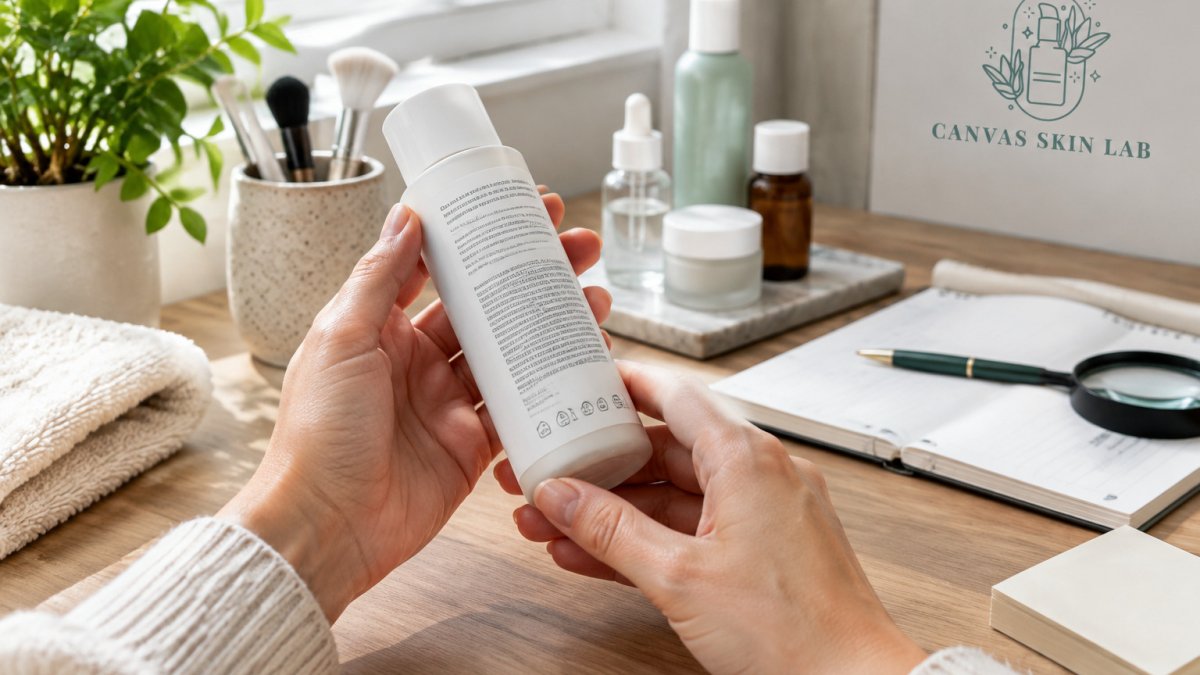
Most competitors hand you a list of questions. The useful part is knowing what a good answer looks like. Below is a claim-by-claim decoder, followed by the checklist itself.
Decoding the most common claim words
- "Clinically tested." Means the product or an ingredient was tested in a clinical setting. It does not mean the test showed a benefit, that the test was controlled, or that the result was significant. Ask for the outcome measured.
- "Clinically proven." A stronger phrase that implies a demonstrated result. Look for the specific endpoint (for example, reduced redness on a graded scale), the sample size, and the duration. Without those, the word is doing marketing work, not evidentiary work.
- "Dermatologist tested." Usually means a dermatologist supervised or reviewed a test, often a patch test for irritation. It speaks to tolerability more than to efficacy.
- "Natural." Describes ingredient origin or sourcing. There is no single legal definition for cosmetics in the United States, so the word can cover a wide range of formulations.
- "Clean." A marketing term with no standardized regulatory meaning. Brands define it themselves, and the definitions vary.
- "Organic." For agricultural ingredients, this can tie to USDA organic certification, but a cosmetic product as a whole is not automatically "organic" just because one ingredient is.
The checklist, with what to look for
- Does the claim name a specific ingredient, or only a general word like "natural"? A named ingredient with a stated role is easier to verify than a category word.
- Is there a stated concentration for the active ingredient? Concentration determines whether a proven ingredient is present at a meaningful level. A common pattern is that the hero ingredient appears near the end of the ingredient list, which suggests a low concentration.
- Was testing done on the finished product, or only on an ingredient in isolation? Finished-product testing is more relevant to what you will actually apply.
- How many people took part, and how long did the test run? Larger and longer is generally stronger, but match the duration to the claim, a barrier-repair claim needs enough time for the barrier to change.
- Does the claim describe a measurable outcome? "Reduced the appearance of redness" with a scale and a timeframe is more checkable than "visibly brighter."
- Was there a control group? A between-group difference is more convincing than a change from baseline.
Marketing claims versus drug claims
In the United States, the line between a cosmetic and a drug matters. Cosmetics are generally intended to cleanse, beautify, or alter appearance, while drugs are intended to treat or prevent disease. A moisturizer that says it "hydrates" is making a cosmetic claim.
Watch out: a claim that cannot answer these questions is not necessarily false, but it is harder to verify, and unverifiable claims are where marketing language tends to outrun the evidence.
The checklist below gives a quick way to check a skincare claim against the questions that matter most.
| Question to ask | What a strong answer looks like | Why it matters |
|---|---|---|
| Does the claim name a specific ingredient? | A named ingredient with a stated role | Category words like "natural" are harder to verify |
| Is a concentration stated for the active? | A clear percentage for the hero ingredient | Low concentration may fall short of the proven level |
| Was the finished product tested? | Testing on the final formula | Ingredient-only testing may not carry over to the product |
| How many people took part, and for how long? | Larger, longer studies matched to the claim | Short or small tests give weaker evidence |
| Is the outcome measurable? | A scale, a measurement and a timeframe | Vague wording like "visibly brighter" is hard to check |
| Was there a control group? | A between-group difference | A change from baseline alone is weaker evidence |
Clinical and Natural as Separate Dimensions, and Where Each Term Stops
Clinical and natural answer different questions. Clinical asks whether something was tested. Natural asks where it came from. A product can be clinically tested and made from synthetic ingredients, or natural and never tested at all. Treating the two terms as opposites is a common mistake.
Each term also has limits. "Natural" has no single legal definition for cosmetics in the United States, so brands use it loosely. "Clinical" can describe anything from a small in-house panel to a formal trial.
Choosing Products You Can Verify for Your Own Skin
Start with your skin type and a clear goal. If your skin is dry and sensitive, a gentle cleanser and a fragrance-free moisturizer are often a better first step than a long list of actives.
Introduce one new product at a time, and give it two to four weeks before judging results. If irritation appears, stop using it. For a broader overview of verifying what you buy, read [7 Steps to Choose Skincare for Sensitive Skin | https://canvasskinlab.com].
At CanvasSkinLab, we want you to have what you need to check products yourself. Get started with CanvasSkinLab and build a routine you can verify.
Frequently Asked Questions
What skincare ingredients are clinically proven?
No ingredient is clinically proven in the abstract. Clinical proof attaches to a specific ingredient at a specific concentration, in a specific formula, tested in a defined study. Retinoids, benzoyl peroxide, and sunscreen filters have strong published evidence for particular skin concerns, and dermatologists frequently recommend them. The practical question is whether the product you are considering was tested at the concentration listed on its label. Look for published studies, dermatologist-led trials, or measurable outcomes such as percentage change in wrinkle depth or lesion counts, rather than trusting the word clinically alone.
Are natural skincare ingredients better than synthetic ingredients?
Not automatically. Natural describes where an ingredient comes from, not how well it performs or how safe it is. Some natural ingredients, such as botanical extracts, can cause contact dermatitis, and many synthetic ingredients are well studied and gentle. Natural products are not automatically gentler, so judge each ingredient on its evidence and your own skin's tolerance rather than its origin story.
How can you tell whether a skincare claim is backed by evidence?
Start by sorting the claim into a category. Cosmetic claims describe appearance, such as making skin look smoother. Therapeutic or drug claims say a product treats a condition, which is regulated more strictly by the FDA. Next, ask what the claim is measured against: a reduction in fine lines in a named study with a sample size is more meaningful than the phrase dermatologist tested. Finally, check whether the study was run on the finished product or only on a single ingredient, because results do not always transfer.
What should you look for in a skincare product study?
Look for the sample size, how long the study ran, whether there was a control group, and what was measured. A study that reports a specific outcome, such as a percentage improvement in hydration after four weeks in 40 participants, tells you far more than a vague satisfaction score. Note whether the study was published in a peer-reviewed journal or only run internally by the brand. Concentration matters too, so check whether the tested amount matches the amount in the product you would buy.